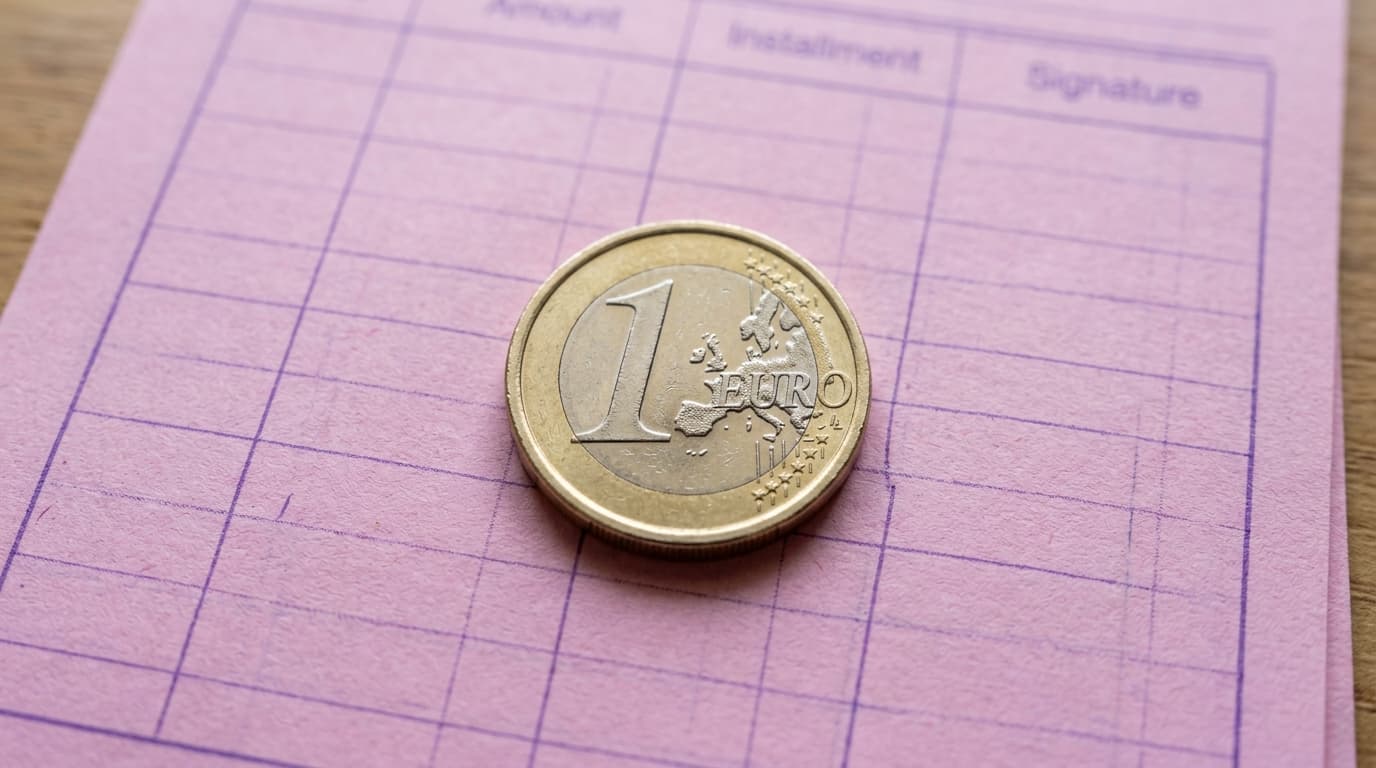
A handset advertised at €1 with a subscription is not a discount. It is a 24-month credit agreement sitting beside the plan, with its own amortisation schedule and a balance that falls due in one go the day you leave. On a €599 device, leaving in month seven costs €448.50.
The €1 phone is a 24-month credit agreement
The €1 is a deposit. Nothing more.
The rest of the handset price is split into twenty-four instalments, billed on a line separate from the plan. Take a smartphone whose reference price on the operator's books is €599. You hand over €1 at the counter, and you owe €598, or €24.92 a month for two years. The telecoms contract and the handset financing are two different commitments, signed the same day, on the same set of forms, and governed by rules that have nothing to do with each other.
I spent seven years behind a counter in Namur, between 2013 and 2020, having those forms signed. Then three years in the cancellations department of a Belgian virtual operator, on the side where you explain the second line to people who only ever looked at the first. The sentence that came up most often started with « but I was told the phone was included ».
What is left to pay if I leave in month seven?
The figure is set out in the amortisation schedule annexed to the contract. Amortisation there is linear and runs no longer than twenty-four months. Here is what that gives on the €599 device used as an example, with a €1 deposit and €598 financed.
| Month of departure | Already paid on the handset | Balance due in one go | Handset total |
|---|---|---|---|
| End of month 6 | €150.52 | €448.50 | €599.02 |
| End of month 12 | €300.04 | €299.00 | €599.04 |
| End of month 18 | €449.56 | €149.50 | €599.06 |
| End of month 24 | €599.08 | €0 | €599.08 |
The few cents of difference between rows come from rounding the instalment. They change nothing in the reasoning, and I leave them visible because that is exactly what an invoice does.
The middle column is the one that catches people out. A subscriber who has understood that cancellation is free from month seven, which is true for the service, receives a €448.50 statement for the handset. There is no billing error in there, and the ombudsman will not reverse it: the amount was written in the annex.
So where is the problem, if the total matches the list price?
The objection is a serious one, and it deserves a straight answer. €1 plus twenty-four times €24.92 comes to €599.08, that is, the reference price of the device. So the credit carries no visible interest. A reader who counts carefully can fairly ask how spreading an outright purchase at zero rate could cost anything at all.
The cost sits elsewhere, in three places.
The first is the reference price itself. It is the manufacturer's list price that serves as the basis for the calculation, not the price the same model trades at with a Belgian retailer six months after launch. The gap between the two appears nowhere on the paperwork, and it is entirely on you.
The second is the freedom you give up. A balance payable in one go turns a reversible decision into a locked one: you can leave, on paper, but the exit carries a price that falls slowly and stays in three figures for more than a year.
The third weighs far more than the other two.
The real extra cost is in the plan the credit is attached to
Handset financing does not attach to just any formula. It attaches to the upper ranges, and that is where most of the money is decided.
On the Belgian price list I recorded on 24 August 2026, the DIGI Belgium entry-level plan is €9 a month for 60 GB, with no commitment, or €216 over two years. The unlimited plans that handset offers are most often attached to sit at €39 at BASE, €40 at Orange Belgium, €41.16 at Telenet and €49.99 at Proximus, with a price applied from the thirteenth month that those four operators do not publish and that I am not going to estimate on their behalf.
Run the figures on the service alone, handset excluded. Twenty-four months at €39 comes to €936. Twenty-four months at €9 comes to €216. The gap is €720, and it rises to €983.76 against the most expensive plan on the recorded list. Meanwhile the handset credit itself costs you nothing in interest.
Put differently: the €1 on the phone is funded by twenty-four months of upper-range plan, and funded generously. It is a perfectly lawful mechanism, written in black and white in the specific terms, and nobody is lying to you. You are simply left looking at the line where nothing happens.
When does a plan with a handset become consumer credit?
When the instalment payment for the handset is structured as hire purchase.
In principle, a contract under which goods are delivered immediately against a price paid in several instalments falls under Book VII of the Belgian Code of Economic Law, which governs consumer credit. That brings pre-contractual information duties, formal requirements on the signed document, and a withdrawal right specific to the credit agreement, separate from the one covering the subscription.
The classification depends on how the operator built the offer, and the structures differ from one brand to another. Two clues can be read straight off the paperwork: whether an amortisation schedule is annexed, and the exact title of the document you sign for the device. If that document carries the words « credit » or « hire purchase », you know where you stand. If it carries neither and no schedule is attached, ask for both in writing before signing, and check the applicable framework with the FPS Economy.
Four figures to have written down before signing
Ten minutes at the counter, and in writing. A spoken answer binds nobody.
- The reference price used for the handset, before any discount, the one the amortisation schedule is built on.
- The handset instalment amount, separated from the plan price, and the exact number of instalments.
- The balance outstanding at month twelve, read off the amortisation schedule rather than estimated from memory by the salesperson.
- The plan price from the thirteenth month, once the introductory promotion ends.
If any one of those four lines cannot be written down, that is not a salesperson problem. It means the contract does not state it clearly, and that is reason enough to look elsewhere.
Trade-in and refurbished: two ways out of the credit
Two options cut the whole reasoning short.
Trading in an old device reduces the financed amount, and therefore the balance due at every month of the schedule. Make it apply to the principal, not to the instalment. A refurbished handset bought outright removes the financing altogether: all that remains is a plan, cancellable without penalty after six months of execution, and nothing to settle.
The law that applies here is federal: the six-month rule, the balance falling due and the consumer credit framework work the same way in Wallonia, Brussels and Flanders. If the operator refuses to correct an exit statement, the Telecommunications Ombudsman Service handles the case free of charge, and the BIPT publishes the framework applicable to Belgian telecoms contracts.
To compare plans on the 24-month cost rather than the headline price, the comparison tool puts them side by side and the mobile plan ranking orders them on that total. On the mechanics of commitment itself, the article with or without a contract covers the six-month rule.
Sources
- BIPT, the Belgian telecoms regulator, framework applicable to telecoms contracts and exit conditions, consulted on 30 August 2026.
- Telecommunications Ombudsman Service, free handling of billing and cancellation disputes, consulted on 30 August 2026.
- FPS Economy, Book VII of the Code of Economic Law, consumer credit and hire purchase, consulted on 30 August 2026.
- Price lists published by Belgian operators, recorded on 24 August 2026. Amortisation calculation based on a device with a €599 reference price, a €1 deposit, and linear financing over 24 months.
GSM & appareils comparator
Compare all gsm & appareils side by side.
Compare now →
Frequently asked questions

Fabrice D. a vendu des abonnements GSM pendant sept ans derrière le comptoir d’une boutique télécom à Namur, entre 2013 et 2020, puis a passé trois ans au service résiliations d’un opérateur virtuel belge — c’est-à-dire du côté où l’on lit les contrats à voix haute à des clients qui ne les avaient pas lus. Il sait donc exactement comment se construit un « GSM à 1 € » : un crédit de 24 mois posé à côté du forfait, avec son propre solde et ses propres conditions de sortie. Chaque mois, il relève les grilles tarifaires publiées par les opérateurs belges, note la date du relevé, et recalcule ce que chaque formule coûte au bout de deux ans, appareil compris. Ce qui l’agace dans son secteur : les prix d’appel affichés en gros pour douze mois, et l’écart — jamais imprimé nulle part — avec ce qui est facturé le treizième.