A second number on the same phone costs €120 to €312 over 24 months, depending on the contract behind it. The dual SIM phone has nothing to do with it: it holds two lines, it does not say who pays for them, who owns them, or how you get out. Price grids recorded as of 15 October 2026.
Three contracts for a second number
Dual SIM is a feature of the device. The second line is a contract, and in Belgium there are three kinds to house it.
| For the second line | Additional card on your account | Second plan in your name, elsewhere | Your employer's line |
|---|---|---|---|
| Example recorded | Orange Mobile Small, 12 GB, €15 minus a €1 discount | hey! mobile S, 15 GB, €5 | plan chosen by the employer |
| Real cost added to your bill | €11 a month without a pack, €8 with an Orange internet pack | €5 a month | €0 |
| Over 24 months | €264 or €192 | €120 | €0, but €96 of taxable benefit |
| Commitment | not published, term tied to the main card | no commitment | the employer's contract |
| Post-promotion price | €15 list price, no promotion on the Small | €5, no promotion announced | not applicable |
| Holder | you, for both lines | you, on two separate contracts | the employer |
| The number, when you leave | portable, with the account's customer number | portable, yours | the employer's, except a number you had brought to it |
The hey!, Orange and DIGI prices are those of the grids published as of 15 October 2026; the Orange discounts are the ones I recorded on the operator's page on 12 October 2026.
The bottom row settles more than the price row does. Two of these three contracts let you leave with the number without asking anyone's leave. The third does not.
One more card on your account: the discount against the dependency
This is the route shops suggest first, and I suggested it too at the counter in Namur: you add a card to the existing account, the multi-card discount kicks in, everything comes on a single bill.
The sum is worth doing to the end, because the discount works both ways. At Orange Belgium, the multi-product advantage page gives a discount per card from two mobile plans. Adding a card therefore also lowers the main line.
| Orange account, main line Unlimited at €40 | Before | After adding a Small | Real cost of the second line | Over 24 months |
|---|---|---|---|---|
| Without an internet pack | €40 | €37 + €14 = €51 | €11 a month | €264 |
| With an Orange internet pack | €33 | €30 + €11 = €41 | €8 a month | €192 |
| Main line Small, without a pack | €15 | €14 + €14 = €28 | €13 a month | €312 |
List prices, excluding twelve-month promotions. A Small card displayed at €15 really costs €8 to €13 a month depending on what is already on the account. That is better than the displayed price, and it is still €72 to €192 more than a €5 plan over two years.
At Proximus, the second line of a Flex+ pack on the Easy plan went from €15 to €10 a month, i.e. €240 over 24 months, on the record published by the Belgian daily L'Avenir on 25 February 2026. I have not rechecked it this month, and the pack page does not publish the price line by line.
The price matters less than the dependency. Orange writes in article 2.5.6 of its postpaid general terms (October 2024 version) that the term of an additional card is determined by that of the main card. The discount, for its part, is cancelled automatically when only one compatible plan remains. And both lines have a single holder, who answers for everything. I set out this mechanism in the article on the family mobile plan and what happens when a line leaves.
For a second number that must stay yours, putting both lines in the same basket is not a serious flaw. But you will no longer be able to leave one without recalculating the other.
How much does a second plan in your name cost?
Five euros a month at the lowest, with no commitment, on the grids published as of 15 October 2026.
| Plan | Price per month | Data | Commitment | Post-promotion price | Over 24 months |
|---|---|---|---|---|---|
| hey! mobile S | €5 | 15 GB | no commitment | €5, no promotion announced | €120 |
| DIGI Belgium, 30 GB | €5 | 30 GB | no commitment | €5, fixed price | €120 |
| Scarlet Red | €8 | 10 GB, 300 minutes | no commitment | €8, fixed price | €192 |
| BASE 15 | €15 | 15 GB | no commitment | €10.50 for as long as you keep the plan, if subscribed before 16 November | €252 |
The contract is separate, and so is the bill. You cancel the second line without touching the first, and you leave with its number for whoever you like. No discount is recalculated anywhere.
For a work line, two details count for more than the price. At DIGI, on the €5, €7 and €9 plans, each text sent beyond the number of texts received is billed at €0.07, according to the consumer organisation Test-Achats in June 2026, and L'Avenir noted in February that there is no voicemail. A number your customers call without reaching an answering service gets noticed quickly. hey!, a brand of Orange Belgium, runs on the Orange network: if your main line is already with Orange, both numbers depend on the same mast.
Who owns the work number in your phone?
Your employer, if it created it. That holds even when the card sits in your private phone.
A company line slipped into the second slot of a personal phone remains a contract between the employer and the operator. You are only its user. When you leave, the number stays with the company, and there is no right to take it with you.
The exception is recent and little known. Since 1 January 2024, article 21/1 of the Act of 3 July 1978 on employment contracts, inserted by the Act of 18 December 2023, lets the worker recover the number they owned before their contract and had handed over to the employer. The request is made in a dated letter, within the month after the end of the contract, and the employer cannot refuse it, as summarised by the Union of Walloon Cities and Municipalities. Once that month has passed, the text no longer helps you.
In 2016, a customer came to see me with a number she had used for fifteen years, transferred to her employer when she joined "to keep things simple". She had just been dismissed. There was no rule at the time, and the number stayed with the company. Under the current law, a dated letter would have been enough.
Private use of a line paid for by the employer also has a discreet price: a flat-rate benefit in kind of €48 a year for the subscription, in force since 1 January 2018, added to taxable pay. That is €96 over 24 months. You do not pay it to the operator: it is added to your taxable base, and your payroll office is the right contact for your case.
The rule is federal: it applies the same way in Liège, in Brussels and in Antwerp.
Does your phone accept two lines?
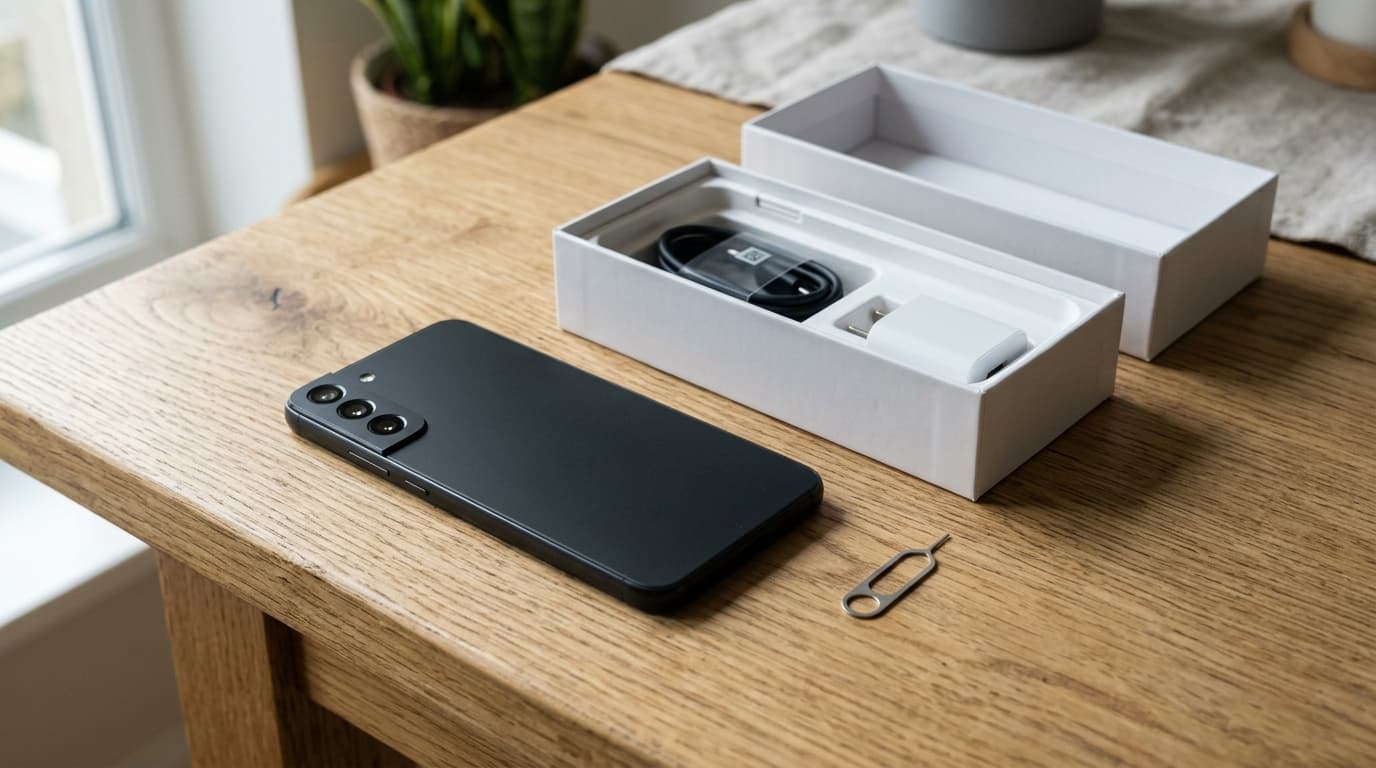
On an iPhone, yes since the iPhone XS and iPhone XR. Apple's documentation states that it combines a nano-SIM and an eSIM, and that the iPhone 13 and later models also accept two eSIMs. For an Android phone, the manufacturer's official spec sheet must mention a dual SIM or "nano-SIM + eSIM" configuration: I do not name a model whose sheet I have not read.
Before activating the second line, check five points:
- the device is not locked to the operator that sold it to you;
- the second line's operator provides an eSIM on that plan, and at what price it replaces it when you change phones;
- the work line's contract allows use in a private device, if the employer has a written policy;
- each account's customer number is written down somewhere, for a future number transfer;
- the line that will carry mobile data has been chosen, and its allowance is enough.
On replacement, the Proximus eSIM page, consulted on 18 October 2026, publishes no amount. It says the QR code cannot be reused and that you have to go back to a shop for a new code. Not published, then: ask for the price before changing devices.
Only one line carries data
Apple puts it plainly: the iPhone uses only one cellular data network at a time.
The practical consequence works in your favour: nothing forces you to pay for data on both lines. A second line at €5 with 15 GB can carry all the data, while the main line keeps the number everyone knows. I would not advise it if the main line is a work line whose data the employer pays for: you would be paying for what it already pays.
Which route for which profile?
For an employee with a company phone line, the employer's line costs nothing on the bill, but keep your personal number on a contract in your name. Never hand it over to the company without noting the date: that date is what opens the one-month window.
For a self-employed person, two separate contracts in your name. A work line cut off because the private line was cancelled, or the other way round, is the scenario to avoid. Before signing a business plan, the question of plans and their price over 24 months is settled with the comparison tool.
For a second private number, a sales listing, an association, the second plan at €5 with no commitment is the cheapest and the simplest to close. The additional card only holds up if your account already has an internet pack, and even then: it costs €72 more over two years.
For a watch, the case is different: it is a shared number, not a second number, and I covered it in the article on the eSIM for a connected watch in Belgium.
Sources
- Orange Belgium, page "L'avantage multi-produits expliqué": discounts per card from two mobile plans, with and without an internet pack, cancellation conditions, recorded on 12 October 2026. General terms for postpaid services, October 2024 version, article 2.5.6.
- Belgian mobile plan grids as of 15 October 2026 (standard rates, VAT included), published by Selectra: hey! mobile S, DIGI Belgium 30 GB, Scarlet Red, BASE 15, Orange Mobile Small.
- L'Avenir, 25 February 2026, prices of additional SIM cards in a Proximus Flex+ pack; 19 February 2026, hey! on the Orange network and voicemail at DIGI.
- Test-Achats, 8 June 2026, DIGI Belgium plans and texts billed at €0.07.
- Proximus, page "eSIM, your digital SIM card", consulted on 18 October 2026.
- Apple, "Utilisation de la double SIM avec une carte eSIM" (Using Dual SIM with an eSIM), consulted on 18 October 2026.
- Union of Walloon Cities and Municipalities (UVCW), 10 January 2024, Act of 18 December 2023 guaranteeing the return of the right to use workers' mobile numbers at the end of the employment contract (Belgian Official Gazette of 29 December 2023).
- Jubel, 17 January 2018, flat-rate benefit in kind for private use of a mobile phone and a subscription, applicable since 1 January 2018.
- BIPT, cancelling a contract and the six-month rule, consulted on 18 October 2026. Telecommunications Ombudsman Service, consulted on 18 October 2026.
- Post-promotion prices that are not published have not been estimated. The real cost of the additional Orange card is calculated on list prices, excluding twelve-month promotions.
GSM & appareils comparator
Compare all gsm & appareils side by side.
Compare now →
Frequently asked questions

Fabrice D. a vendu des abonnements GSM pendant sept ans derrière le comptoir d’une boutique télécom à Namur, entre 2013 et 2020, puis a passé trois ans au service résiliations d’un opérateur virtuel belge — c’est-à-dire du côté où l’on lit les contrats à voix haute à des clients qui ne les avaient pas lus. Il sait donc exactement comment se construit un « GSM à 1 € » : un crédit de 24 mois posé à côté du forfait, avec son propre solde et ses propres conditions de sortie. Chaque mois, il relève les grilles tarifaires publiées par les opérateurs belges, note la date du relevé, et recalcule ce que chaque formule coûte au bout de deux ans, appareil compris. Ce qui l’agace dans son secteur : les prix d’appel affichés en gros pour douze mois, et l’écart — jamais imprimé nulle part — avec ce qui est facturé le treizième.