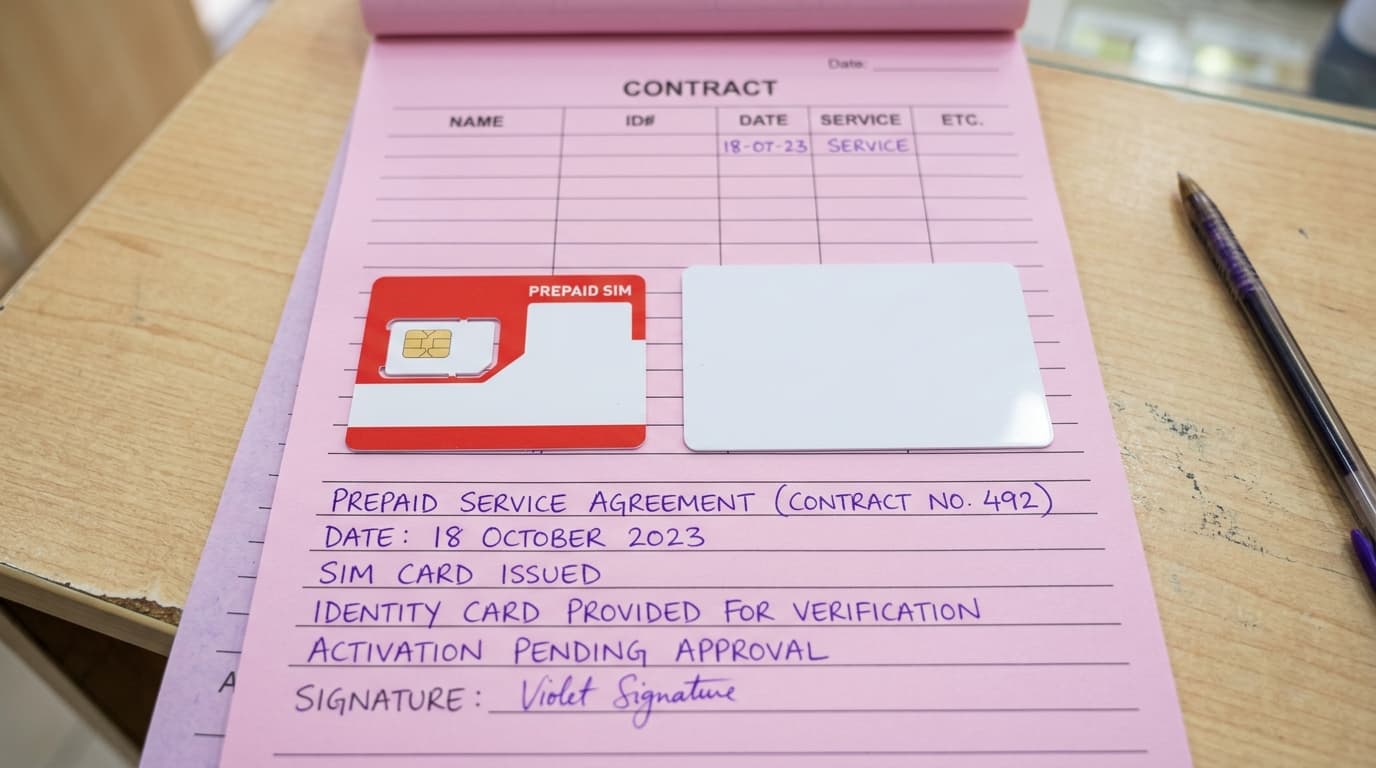
Yes. In Belgium a prepaid SIM is only activated once the person using it has been identified, and that holds for every operator. The rule is ten years old, but it was tightened in May 2024: an active card can no longer be lent to just anyone, and some registrations lapse after eighteen months.
Do you have to register to activate a prepaid SIM?
Yes, with no exception.
The obligation comes from the Act of 1 September 2016 and the Royal Decree of 27 November 2016, adopted after the Brussels attacks. The operator activates the card only once identity is established. Proximus says it plainly on its page: without registration, no calls made or received, no texts, no mobile internet.
I was behind a shop counter in Namur when the rule came into force, in December 2016. Cards already in circulation had to be regularised by 7 June 2017. For six months, customers came in with cards bought at a newsagent years earlier, convinced that a product paid for in advance tied them to nothing. A prepaid card is a contract all the same, with general terms, a holder and deadlines.
How do you register, operator by operator?
In a shop with an identity document, or online using each operator's own methods.
Checked on 9 October 2026, in public help pages and general terms. Cells I could not read stay "not published".
| Operator | Registration methods | Without registration | Validity |
|---|---|---|---|
| Proximus | Belgian electronic identity card with PIN and reader, MyProximus for an existing customer, text "IDENT" to 8804 from a Proximus line, shop | no calls, no texts, no mobile internet | permanent, except registration through a bank top-up: 18 months |
| Orange Belgium | valid identity document at a point of sale, online registration with the electronic identity card | card not activated; possible blocking if you ignore a request to identify yourself (article 3.3) | not published |
| BASE | itsme, photo of a document and of your face in the My BASE app, login of an existing customer, card reader, form | not published | not published |
I did not check Lycamobile, Ortel Mobile or Mobile Vikings that day. The pages consulted are Proximus on registration and BASE on prepaid cards.
One detail for parents: Proximus's prepaid FAQ states that the Kids-ID is not accepted in its shops. A minor registers online, or a parent does it for them.
Can you give or lend your card to someone?
Only to a relative. This is the point most online pages have not updated.
The Royal Decree of 3 May 2024, published in the Belgian Official Gazette on 30 May 2024, rewrote article 5: the person who registers may not pass an active prepaid card on to another person. The report to the King specifies that passing on covers sale, gift and loan, and that no exception is made for occasional use. The people the card may go to are listed:
- your spouse, legal cohabitant and the people registered in the same household;
- parents, grandparents, children, grandchildren, brothers and sisters, yours as well as your spouse's;
- a third party already identified with the operator;
- the natural person for whom a company took out the card.
The contract points the same way, more bluntly. Orange Belgium's general terms for prepaid cards (October 2024 version) forbid the customer in article 3.1 to "transmit, assign, rent" the card (my translation of the French text), and article 3.4 makes the customer liable for its use "even in the event of theft or loss". The FAQ of the regulator BIPT (IBPT in French, document in French) gives the practical consequence: the registered person is presumed to use the card, and the police will come to them.
Helping out a colleague with an old card lying in a drawer, a gesture I saw a hundred times, therefore fits no category. The clean way out takes one sentence: hand over a card that is not activated, which the other person will register in their own name.
Registration through a bank top-up lapses after 18 months
At Proximus, registration is permanent, unless it was made during a top-up paid through the bank. In that case it is valid for eighteen months, and it has to be done again.
Nobody writes that date down.
What happens to the credit on a blocked or forgotten card?
It has a deadline, and the clock runs whether the card works or not.
At Orange Belgium, article 1.2 of the terms is clear: topped-up credit stays valid for twelve months, and without a new top-up within that time the customer loses the unused call credit. The number expires with it, after a warning text sent one month earlier. The reserve meant for electronic payments is capped at €150: that is the most that can vanish in one go.
Proximus counts differently. The Pay&Go card is valid for twelve months from the first call, a €5 top-up extends it by one month, a top-up of a higher amount by twelve months. And a card left unused for more than six months is deactivated automatically, with no refund.
I ran the numbers for someone who keeps a backup number and hardly uses it. With €5 top-ups, it takes twelve a year: €60. With a single €10 top-up, taken here as a working assumption, validity runs for twelve months: six times cheaper for the same number. You still have to make a call every six months, otherwise the card drops anyway.
A card blocked for lack of registration suspends none of these deadlines. The texts I read provide for no extension and no goodwill gesture.
Can you keep your number when moving from prepaid to a plan?
Yes, and the credit follows if you stay with the same operator.
Orange Belgium provides in article 1.5 for converting the card into a subscription as long as it has not expired, the remaining credit being deducted from the first invoice. Proximus applies the same deduction. Towards another operator, it is an ordinary number port: the new operator handles it, and Proximus writes that it closes the Pay&Go card once the number is activated elsewhere. The full procedure is in the article on switching operator while keeping your number.
Two traps, both contractual. The number must be ported by the registered person: a card still in the name of a parent or a former partner blocks the request. And the credit refund is not automatic. At Orange Belgium, article 2.8 requires you to claim it within one month, minus administrative costs, top-up bonuses excluded.
Before signing the plan that replaces the card, compare its cost over twenty-four months in the mobile plan ranking or in the comparison tool.
What should you do if the card is lost or stolen?
Tell the operator within twenty-four hours. The deadline appears in the BIPT FAQ and in article 3.4 of Orange Belgium's terms, which leaves the customer liable for use until that call.
Which step for which situation?
| Your situation | Risk | What to do |
|---|---|---|
| New card bought in a supermarket | inactive card | Register it online or in a shop before first use |
| Card registered during a bank top-up at Proximus | registration void after 18 months | Note the date, register again through a permanent method |
| Card meant for a child or a parent | you remain the registered person | Allowed; have them register themselves if the operator permits it |
| Card to hand to a friend or a colleague | passing on forbidden | Hand over a non-activated card, which they will register in their own name |
| Rarely used backup number | credit and number lost | One top-up a year at Orange Belgium, one call every six months at Proximus |
| Moving to a subscription | forgotten credit | Check the card is in your name, ask for the deduction or the refund |
| Card lost or stolen | use charged to you | Call the operator within 24 hours |
| Disputed blocking | credit expiring during the dispute | Write to the operator, then to the Ombudsman Service |
The rule is federal: it is the same in Namur, in Brussels and in Ghent.
Sources
- Royal Decree of 27 November 2016 on the identification of the end user of mobile services provided on the basis of a prepaid card; amending Royal Decree of 3 May 2024, published in the Belgian Official Gazette on 30 May 2024: article 5 and report to the King, consulted on 9 October 2026.
- BIPT (IBPT), frequently asked questions on the identification of prepaid cards: accepted documents, transfer, loss or theft within 24 hours, consulted on 9 October 2026. This document predates the 2024 amendment.
- Proximus, page "Identify your prepaid card" and Pay&Go frequently asked questions: methods, 18-month validity of registration through a bank top-up, card validity, deactivation after six months without use, consulted on 9 October 2026; undated prepaid FAQ in PDF format, for the Kids-ID and minors.
- Orange Belgium, general terms for prepaid cards, October 2024 version (in French): articles 1.2, 1.3, 1.5, 2.8, 3.1, 3.3 and 3.4, consulted on 9 October 2026.
- BASE, help page on mandatory identification for prepaid SIM cards, consulted on 9 October 2026.
- The €10 top-up is a working assumption and not a recorded price. No subscription is cited by its price in this article.
Lexique & droits comparator
Compare all lexique & droits side by side.
Compare now →
Frequently asked questions

Fabrice D. a vendu des abonnements GSM pendant sept ans derrière le comptoir d’une boutique télécom à Namur, entre 2013 et 2020, puis a passé trois ans au service résiliations d’un opérateur virtuel belge — c’est-à-dire du côté où l’on lit les contrats à voix haute à des clients qui ne les avaient pas lus. Il sait donc exactement comment se construit un « GSM à 1 € » : un crédit de 24 mois posé à côté du forfait, avec son propre solde et ses propres conditions de sortie. Chaque mois, il relève les grilles tarifaires publiées par les opérateurs belges, note la date du relevé, et recalcule ce que chaque formule coûte au bout de deux ans, appareil compris. Ce qui l’agace dans son secteur : les prix d’appel affichés en gros pour douze mois, et l’écart — jamais imprimé nulle part — avec ce qui est facturé le treizième.