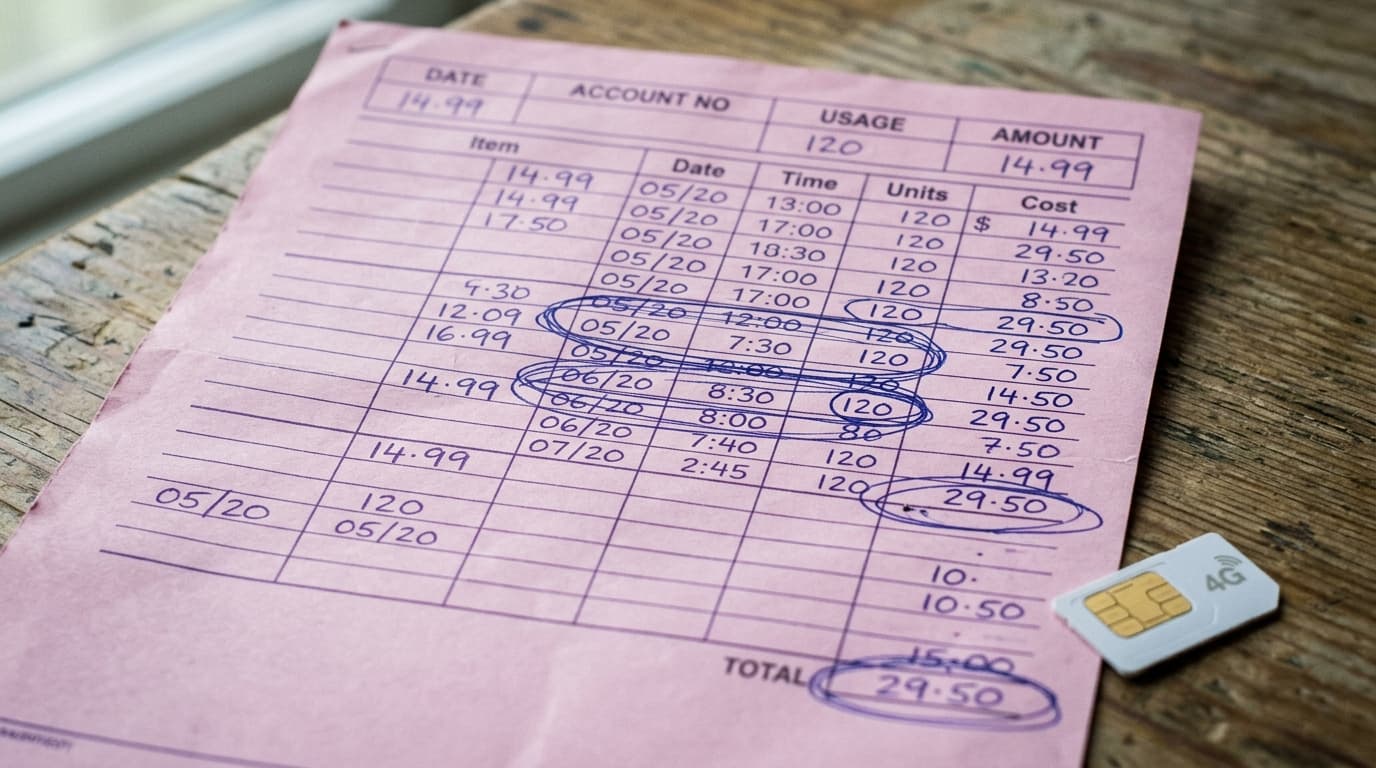
A Belgian mobile bill mixes two calendars: the plan is paid in advance, out-of-bundle use is paid afterwards. Everything else follows from that. And somewhere on the page, two dates tell you from when you can leave with no termination fee and no handset balance. Almost nobody reads them.
Between 2013 and 2020, behind the counter in Namur, the question that came back most after a signature was not about the network. It was “why is my first bill €80 when I was told 39?”. The answer fits in one calculation, and I redo it below.
What must a mobile bill contain in Belgium?
A summary, a breakdown by service category, and two exit dates.
The BIPT, the Belgian telecommunications regulator, sets a minimum content. The total for the period comes first, then the breakdown by category: subscription, calls, data, options, with the number of units charged and the discounts applied. The regulator adds items that only matter on the way out, and those are the ones I care about:
- whether the contract is fixed-term or open-ended;
- for a fixed-term contract, the date from which no early termination fee is due any more;
- for a financed handset, the date from which no residual value is left to pay;
- a reference to the official price simulator meilleurtarif.be;
- the option of an itemised bill, a basic one at least every three months and a finer one on request, at no cost.
A bill that does not carry those two dates is not compliant. Ask for them in writing, and keep the answer.
How do you read your bill line by line?
Six lines, in this order. It is the order in which I checked them with customers who came back to the shop.
- The billed period. It is at the top. The fee covers the month that is starting; Orange Belgium writes in its general terms that fees are “facturées au début de la période de facturation concernée”, Telenet that they are paid “maandelijks en voorafgaandelijk”.
- The plan fee. The monthly price of the service alone. Compare it with the price written in your particular terms, not with the one in the advert.
- The pro rata. It only appears on the first bill, or after a plan change mid-month. It charges the remaining days of the period already started.
- The handset instalment. A separate line, or a separate document. It repays a credit, it is not part of the plan.
- The discounts. A negative line, with its duration. On the day it disappears, the fee does not change: the discount is what drops away.
- Out-of-bundle charges. Calls beyond the allowance, data beyond the allowance, roaming outside the zone, premium-rate services. They cover the period that has ended, so the month before.
If a line fits none of those six boxes, that is the one to question first.
Why is the first bill higher?
Because it bills two periods at once.
Take my standard case: an unlimited plan at €39 a month, 24-month term, price after the promotion not published, site rate card checked on 24 August 2026, with a €599 handset (€1 down payment, €598 financed over 24 months, so €24.92 a month). Activation on 17 October, billing period aligned on the first of the month. In principle, the first bill carries the fifteen days of October pro rata, then November in advance.
| Line | Calculation | First bill | Next bill |
|---|---|---|---|
| October pro rata | €39 × 15 / 31 | €18.87 | €0 |
| Fee for the following month | monthly price | €39.00 | €39.00 |
| Handset instalment | €598 / 24 | €24.92 | €24.92 |
| Total | €82.79 | €63.92 |
The €18.87 gap does not come back. The exact calendar depends on the operator: Proximus writes that its first bill “peut être expédiée entre deux dates normales de facturation”, and it bills monthly or every two months. Read the period at the top of the page before concluding there is a mistake.

Two dates to get out
The first date frees the service, the second frees the handset. They almost never fall on the same day.
In my standard case, the early termination fee disappears after six months of performance: that is the Belgian rule, set out in the article on cancelling without fees. The residual value of the handset runs until month twenty-four: €299 still owed at month 12, according to the amortisation schedule of the €1 phone. Leaving at month 7 costs nothing on the service, and €423.58 on the handset.
How long do you have to dispute a line?
Far less than people think, and not the same everywhere.
On 17 October 2026 I read the consumer general terms of three operators. The gaps are real, and they appear on no bill.
| Clause | Proximus (mobile GTC, version V.20210816) | Orange Belgium (postpaid GTC of 15 October 2024) | Telenet (GTC, undated version) |
|---|---|---|---|
| Billing cycle | monthly or every two months | monthly | monthly |
| Fee | not specified in the GTC | start of the period | in advance |
| Payment deadline | the one on the bill | 10 days, unless a longer one is shown | due date on the bill |
| Dispute deadline | 30 days after issue | three months after issue | two months after the billing date |
| Itemised bill | at no cost via MyProximus or on request | at no cost on request | on request, duplicate may be charged |
| Reconnection | flat fees, amount not published in the GTC | no suspension or reactivation fees | not recorded |
Thirty days at Proximus means an end-of-month bill disputed before the next one arrives. The fourteen-day deadline you often read appears in none of the three texts. Dispute in writing, within your contract's deadline, and pay the part you do not dispute. Links to the two texts I could open: Proximus mobile general terms and Orange Belgium general terms (both in French).
What does a late bill cost?
Less than the general terms suggest: the law caps each item.
Proximus and Orange Belgium write that reminders “donnent lieu à la facturation de frais administratifs forfaitaires”. The legal framework, set out by the BIPT and by the FPS Economy, sets caps:
| Item | Cap |
|---|---|
| First reminder | €0 |
| Each later reminder | €10 |
| Compensation, balance up to €150 | €20 |
| Compensation, balance from €150.01 to €500 | €30 + 10% of the bracket |
| Compensation, balance above €500 | €65 + 5% of the bracket, €2,000 at most |
| Late-payment interest | legal rate, 5.25% according to the FPS Economy |
| Reconnection after suspension | €30 |
Before a full cut-off, the operator must go through a minimum service: emergency calls, incoming calls and texts. These rules apply in the same way in Wallonia, Brussels and Flanders, the matter is federal.
At month thirteen, one line disappears
It is the discount line. On the day the welcome promotion drops away, the bill goes up without any new line appearing, and the amount that follows is published by none of the major operators on the rate card checked on 24 August 2026. I do not estimate it. A rise in the fee itself is something else, with its own rights: the article on mobile plan price increases sets them out.
To compare plans on their 24-month cost rather than on the first bill, the comparison tool puts them side by side, and the mobile plan ranking orders them on that total. If the operator does not correct a disputed line within the deadline, the Telecommunications Ombudsman Service handles the file at no cost after a first written complaint.
Sources
- BIPT, “Vous avez droit à une facture” and “Facture impayée”, consulted on 17 October 2026.
- FPS Economy, ConsumerConnect, “Frais de rappel pour une facture télécoms”, consulted on 17 October 2026.
- Proximus, General terms for the Mobile Communication Service, version V.20210816, articles 5.1 to 7.5 and 12.1, read on 17 October 2026.
- Orange Belgium, postpaid general terms of 15 October 2024, articles 6.1 to 6.9 and 8.1.1, read on 17 October 2026.
- Telenet, Algemene voorwaarden, undated version, articles 7.4.1, 8.1 to 8.8.1 and 15.2, read on 17 October 2026.
- Site rate card recorded on 24 August 2026; amortisation schedule built on a €599 handset, €1 down payment, linear financing over 24 months.
Lexique & droits comparator
Compare all lexique & droits side by side.
Compare now →
Frequently asked questions

Fabrice D. a vendu des abonnements GSM pendant sept ans derrière le comptoir d’une boutique télécom à Namur, entre 2013 et 2020, puis a passé trois ans au service résiliations d’un opérateur virtuel belge — c’est-à-dire du côté où l’on lit les contrats à voix haute à des clients qui ne les avaient pas lus. Il sait donc exactement comment se construit un « GSM à 1 € » : un crédit de 24 mois posé à côté du forfait, avec son propre solde et ses propres conditions de sortie. Chaque mois, il relève les grilles tarifaires publiées par les opérateurs belges, note la date du relevé, et recalcule ce que chaque formule coûte au bout de deux ans, appareil compris. Ce qui l’agace dans son secteur : les prix d’appel affichés en gros pour douze mois, et l’écart — jamais imprimé nulle part — avec ce qui est facturé le treizième.