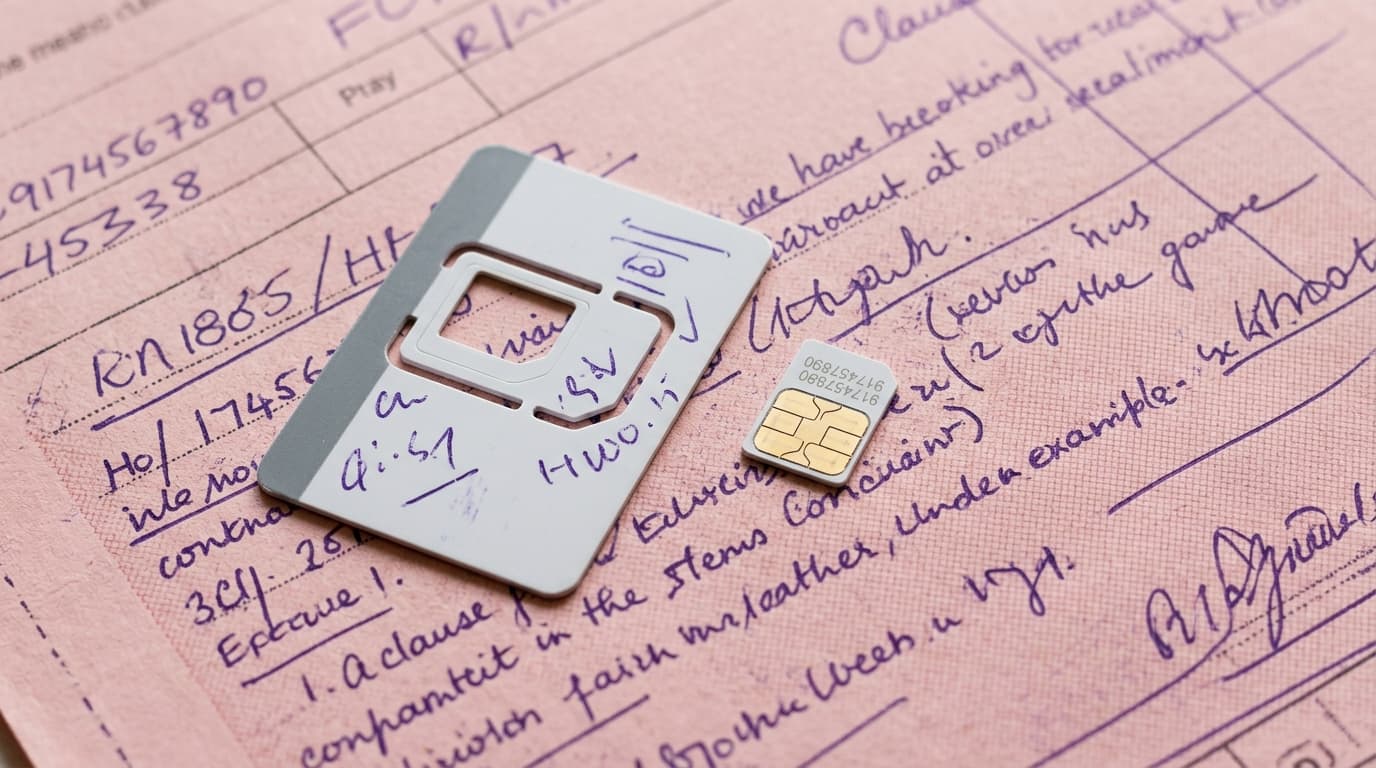
The PIN code is the one you choose. The PUK code is the one the operator assigns, and only the operator can give it back to you. Three wrong PIN codes block the SIM card, ten wrong PUK codes make it unusable. Meanwhile, the plan keeps being billed: that is written in the general terms, not in the help page.
PIN code versus PUK code: two codes, two owners
The PIN is yours. The PUK is the operator's.
The PIN code, for personal identification number, protects the card against whoever picks up your phone. It has four digits at BASE, it comes with the card, and you replace it with your own on day one. The PUK code, the personal unblocking key, has eight. It serves one purpose: reopening a card that three wrong PINs have shut.
| PIN code | PUK code | |
|---|---|---|
| Who sets it | the operator at first, then you | the operator, once and for all |
| Length | 4 digits | 8 digits |
| Can it be changed | yes | no, it is tied to the card |
| Number of attempts | 3 | 10 |
| After the last attempt | card blocked, PUK requested | card unusable, to be replaced |
| Where it is written | card holder, welcome letter | card holder, welcome letter, customer area |
| Price of a mistake | €0 if you have the PUK | a new card and days without a line |
The last row is the only one I care about. I ran a counter in Namur from 2013 to 2020, and the scene played out every week: a customer walks in with a phone asking for eight digits, he has already tried six or seven at random, and he has three attempts left before losing the card. Nobody had told him there was a counter.
Where is the PUK code written, operator by operator?
On the plastic holder you snapped the card out of, first. Then in the customer area.
Recorded on 4 October 2026, in each operator's public help pages and contract documents. The cells I could not read stay "not published".
| Operator | Where to read the PUK | Backup by phone | Replacement card |
|---|---|---|---|
| Proximus | card holder, MyProximus | not published | not published |
| Orange Belgium | card holder, welcome letter, customer area, "Mes appareils" section | 5000, options 4 then 1 | €0, a few working days online, a few hours in a shop |
| BASE | card packaging, My BASE, My BASE app | not published | physical card or eSIM to order in My BASE, amount not published |
| Telenet | not published | not published | one-off €5 on the bill after loss or theft, activated immediately in a shop |
| Scarlet | handed over with the card, under article 3.1 of the special terms | not published | €0 for a manufacturing defect, at your expense if the card was damaged, amount not published |
The pages consulted are those of Orange Belgium on PIN and PUK codes and of BASE on the PIN code.
A reading trap: many of the how-to guides you find in French are written for customers of French operators, with short numbers and customer areas that do not exist here. Orange Belgium and Orange France are two companies, two customer areas, two numbers. 5000 is the Belgian one.
Ten attempts, then the card is dead
Orange Belgium puts it bluntly: after 10 wrong PUK codes, "nous bloquerons votre carte SIM" (we will block your SIM card). BASE then displays the message "SIM card rejected", and states that the card is no longer usable.
No code reopens it after that.
The card stays the operator's, the bill stays yours
This is the section the help pages do not contain, and the one that separates an annoyance from an expense.
The SIM card does not belong to you. Proximus's general terms for the mobile service (version of 16 August 2021, consulted on 4 October 2026) say so in article 2.1.3: the card "reste la propriété exclusive de Proximus" (remains the exclusive property of Proximus). Article 2.5.2 adds that the PIN code and the PUK code are assigned by Proximus and given to the customer when the SIM card is handed over. Scarlet's special terms, version of 1 January 2026, repeat the idea in article 3.1 and state that the operator may change the programming of the SIM card at any time.
So you hold an object that is not yours, protected by a code you did not choose, and you answer for it all the same. Proximus's article 9.2 makes the customer liable for use of the card by any person whatsoever and on any mobile device whatsoever, "même en cas de perte ou de vol" (even in the event of loss or theft). The only way out is to report it immediately by phone: usage after that point is no longer owed. Scarlet words the same rule in article 3.2, the customer remaining liable until the moment he asks Proximus to suspend the SIM card. That is why the PIN code is not a formality: it is what limits that liability for as long as the loss has not been reported.
Then comes the sentence that costs money. At Proximus: "Tout autre paiement autre que celui afférant au montant de communications passées après la notification précitée reste dû." Any payment other than calls made after the report remains due. The subscription carries on. The contract provides for no suspension of the plan because the card is blocked, lost or being replaced, and nothing in the texts I read provides a gesture for the days without a line.
I ran the numbers on a plan at €39 a month (price grid recorded on 24 August 2026, commitment varying with the promotion, post-promotion price not published). Over a thirty-day month, that is €1.30 of plan per day. With the site's reference device, €599 of which €598 financed over 24 months, the €24.92 instalment adds €0.83 per day. Five days waiting for a card in the post come to €6.50 of plan paid without a line, and €10.65 phone included.
The sum is modest. The principle is not: the card is the operator's, the risk sits with you.
How much does a replacement card cost?
Between €0 and €5 where the amount is written down. Elsewhere, you have to ask.
Orange Belgium is the only one of the five to spell it out: the new card costs nothing, you keep your number and the benefits of your tariff plan, and the card arrives within a few working days if you order it in the customer area. In a shop, it is activated within a few hours. Telenet announces a one-off €5 on the bill for the card replacing that of a lost or stolen device. Proximus and BASE describe the order without showing an amount.
The number, the plan, the contract term and the handset balance do not move. A new card carries a new ICCID identifier and a new PUK code, nothing else. If you are preparing to switch operator, the new ICCID is the one to write down: the steps are in the article on switching operator while keeping your number.
Who can ask for a line's PUK code?
The contract holder, and that is the whole problem with lines paid for by someone else.
The PUK is displayed in the customer area, which belongs to whoever signed. The teenager whose line is in a parent's name, the employee whose card is in the employer's name, the partner added to a bundle: none of the three will read it alone. Telenet writes it down for in-store collection, reserved for the account holder. Before entering an eighth attempt, call the person whose name is at the top of the contract.
Before the tenth attempt
The order matters, and it comes down to five moves.
- Stop guessing as soon as the phone asks for eight digits: every attempt is counted.
- Look for the card's plastic holder or the welcome letter, where the PUK is printed.
- Open the customer area from another device, or ask the contract holder to do it.
- Call the operator from another line if the customer area gives nothing.
- Once the card is reopened, choose a PIN you will remember, and photograph the holder before putting it away.
The rule is the same in Namur, in Brussels and in Ghent: electronic communications law is federal, and no Region adds anything to it.
If the operator bills you for a card whose defect is not your doing, or refuses to give a code to the contract holder, write to it first. With no answer, the Telecommunications Ombudsman Service handles the case at no cost to you, and the FPS Economy (the Belgian federal economy ministry) publishes the framework that applies to telecommunications contracts.
Sources
- Proximus, general terms for the mobile communication service, version of 16 August 2021: articles 2.1.3, 2.5.2 and 9.2, consulted on 4 October 2026; help page on SIM cards, consulted on 4 October 2026.
- Scarlet, special terms for the mobile telephony service, version of 1 January 2026: articles 3.1, 3.2 and 3.3, consulted on 4 October 2026.
- Orange Belgium, help pages "Comment changer votre code PIN ou retrouver votre code PUK ?" and "Comment changer ma carte SIM ?", consulted on 4 October 2026.
- BASE, help page on the PIN code and the PUK code, consulted on 4 October 2026.
- Telenet, help page on the new SIM card, consulted on 4 October 2026.
- The site's price grid, recorded on 24 August 2026; reference device at €599, €1 upfront, €598 financed in equal instalments over 24 months. The price applied after the promotional period is not published and has not been estimated.
Lexique & droits comparator
Compare all lexique & droits side by side.
Compare now →
Frequently asked questions

Fabrice D. a vendu des abonnements GSM pendant sept ans derrière le comptoir d’une boutique télécom à Namur, entre 2013 et 2020, puis a passé trois ans au service résiliations d’un opérateur virtuel belge — c’est-à-dire du côté où l’on lit les contrats à voix haute à des clients qui ne les avaient pas lus. Il sait donc exactement comment se construit un « GSM à 1 € » : un crédit de 24 mois posé à côté du forfait, avec son propre solde et ses propres conditions de sortie. Chaque mois, il relève les grilles tarifaires publiées par les opérateurs belges, note la date du relevé, et recalcule ce que chaque formule coûte au bout de deux ans, appareil compris. Ce qui l’agace dans son secteur : les prix d’appel affichés en gros pour douze mois, et l’écart — jamais imprimé nulle part — avec ce qui est facturé le treizième.